|
Three in the afternoon. That is when it arrives for me. Not hunger exactly. More a feeling that something cold and sharp would fix the next hour. For years the answer was a Coke. Before we get to what I drink now, one thing about three o'clock itself. It is not always a free standing event. When I eat a lunch that sends my blood sugar up fast, the fall afterwards tends to arrive somewhere in the middle of the afternoon. And a fall is a very good way to make a person want something sweet. So some of what feels like a craving at three is just the lunch I ate at one, catching up with me. That is worth knowing before you go hunting for willpower. Sometimes the fix is earlier in the day than the problem. Yesterday I showed you that the zero sugar version does nothing to my blood sugar. Today I want to show you what the original does, and then walk down the list of what I tried instead. One can of Coca-Cola carries 39 grams of sugar. That is the company's own number. Here is what it did on an empty afternoon stomach, against the thing I drink now…
This is one person's experiment, not medical advice. Everyone's body responds differently. Seventy eight points. The biggest rise I have recorded since I started writing this. Bigger than the cup of grapes. Bigger than the banana. Sugar dissolved in water arrives faster than sugar locked inside a fruit. There is no fiber to slow it and nothing to chew. In other words, the can is the quickest way I know to put 39 grams of sugar into your blood. And the drop afterwards is the part that keeps the habit going. Look at the right hand side of that red line. It does not settle back gently. It falls. By half past four I wanted another one. I used to read that as a long day. I now think a fair bit of it was the first can. The ladder I worked down I did not go from a Coke to tap water. I tried that. I lasted four days, and then I bought two cans on the way home to make up for it. The thing I had got wrong was treating it as one decision. It is four, and they are easier apart than together. What worked was moving one rung at a time…
Worth doing, and worth skipping
That last one needs saying properly, because yesterday's flat line could be read the wrong way. A diet drink is a good answer to a sugary drink. The research I went through yesterday is much less sure that it is a good answer to water. So I treat it as a step on the way down, not the place to stop. The other thing worth knowing is how fast your taste changes once you start moving. I opened a regular Coke a few months into this, out of curiosity, expecting to enjoy it. I could not finish it. It tasted like syrup. Nothing about the drink had changed, so the thing that moved was me. That is worth saying to anyone staring at step one and thinking they could never give it up. You are not giving anything up at the start. You are only changing what normal tastes like, and that moves on its own once you stop feeding it.
One more thing, because it caught me out and nobody warned me. If you drop the soda entirely, you are dropping the caffeine with it. A can carries about as much as half a cup of coffee. Take two cans a day out of a person who has been drinking them for a decade and the headache that follows has nothing to do with sugar. I spent two days blaming the lack of sugar for something the lack of caffeine was doing. So if you are going from several a day to none, come down over a week rather than overnight, and do not read the first bad afternoon as a sign that you need the sugar back. My wife thinks the salt in the sparkling water is a step too far. She may be right. It took me about three weeks to stop noticing it, and now a glass without it tastes like it is missing something. Tomorrow, three clear fizzy drinks that all look equally harmless in the glass. One of them is not. — Stay steady |
What I drink now at three in the afternoon
A regular Coke carries 39 grams of sugar and raised my blood sugar 78 points. Here is the ladder of swaps I worked down, and where I landed.

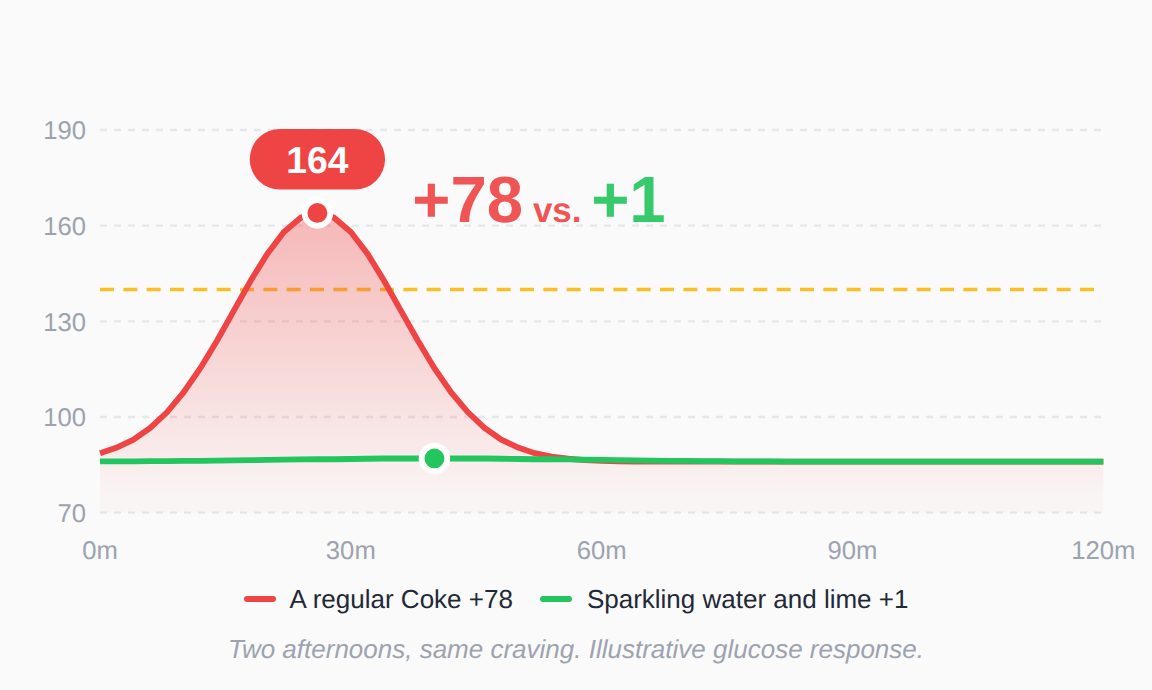
This is one person's experiment with a glucose monitor, not medical advice. Everyone's body responds differently.
Browse every issue