|
Pop quiz. Three breads. Same weight of carbohydrate in each, about thirty grams. Three mornings, same hour, empty stomach, nothing on top. White. Whole wheat. And the real sourdough I drove across town for on Saturday. Before you scroll, pick the one you think raised my blood sugar most. Most people get the winner right. Almost nobody gets the gap right.
Your turn Which one did the most to my blood sugar? Pick before you scroll.
Got one? Keep going. ↓ The answer
This is one person's experiment, not medical advice. Everyone's body responds differently.
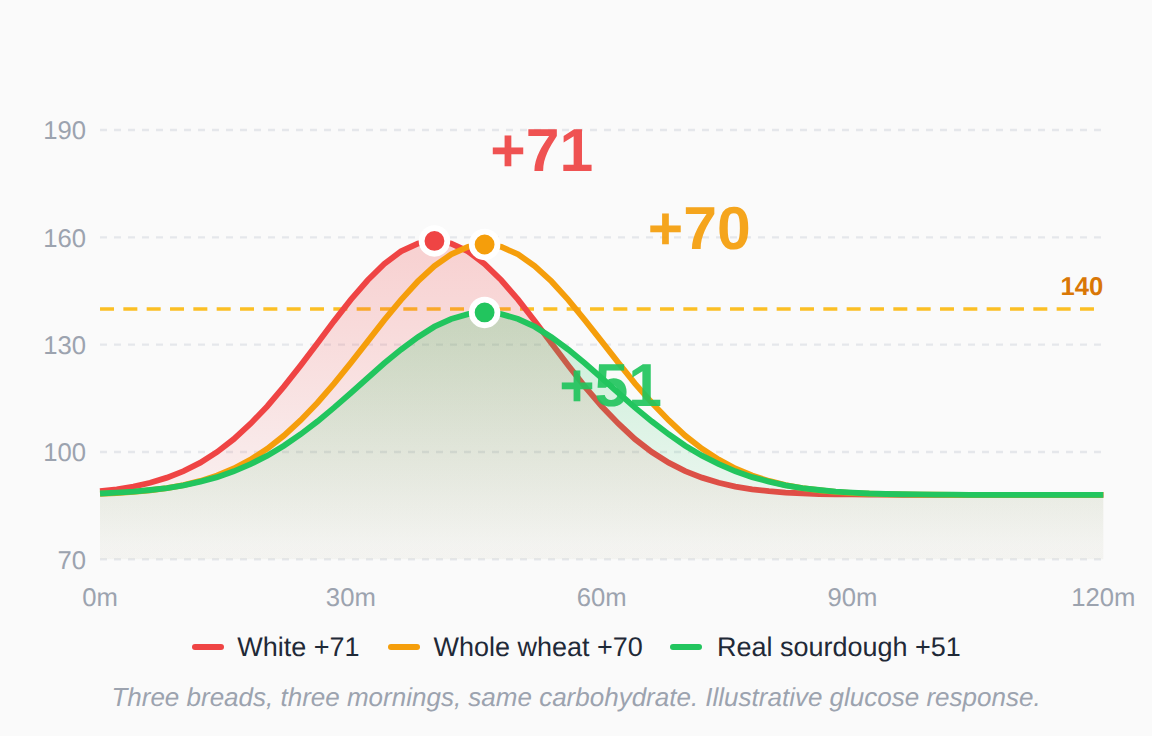
White won. By one point. One point is nothing… that is my monitor breathing. In other words, the brown loaf and the white loaf did the same thing to me. If you picked whole wheat as the safe middle option, you picked the way I would have picked a month ago. Why the brown one did not help Here is the number that explains it, and it is not from my kitchen. The University of Sydney keeps the reference tables the whole field uses. They put white wheat bread at 75 on the glycemic index. Whole wheat bread comes in at 74. Seventy five and seventy four. That is the global reference set, built from hundreds of tested foods. Not a one off. The reason is milling… A wheat kernel is a parcel. Starch packed inside, bran wrapped around the outside. Whole wheat flour keeps the bran, which matters for other reasons. But it grinds the whole parcel to dust first. And dust is dust. Your gut does not have to break into anything, because there is nothing left to break into. In other words, the bran comes along for the ride. It does not slow the starch down. What does slow it down is leaving the grain in one piece… The same tables put specialty grain breads, the category covering loaves built from whole kernels and seeds rather than flour alone, at 53. Fifty three against seventy four. Same grain. Different shape. The word on the front of the bag This is where the shopping gets annoying. In the United States a product can carry a whole grain health claim when 51 percent of its weight is whole grain ingredients. The Whole Grains Council stamp starts at eight grams of whole grain in a serving. Neither number says anything about how finely the grain was ground. And the grinding is the part that moved my monitor. A food writer put it plainly this spring: whole grain has turned into a loosely defined marketing term. I think that is fair, and I say it as someone who has been buying the brown loaf for years on trust. The four second check I use now There is a rough shortcut, and it takes about as long as reading the price. Turn the pack over. Divide total carbohydrate by fiber. Ten or lower, and the loaf tends to behave better. Much above ten and you are mostly buying flour with a tan. It is a rule of thumb, not a law, and I would not bet a diagnosis on it. But it has matched my own readings better than anything printed on the front.
So the podium, on three ordinary mornings. White and whole wheat, tied. Real sourdough, twenty points clear of both. One note on that sourdough number, because sharp eyed readers will have it ready. On Monday the same bread gave me 58. That was a bigger slice off a bigger loaf. Today everything was weighed to match, which is the only way this comparison means anything. Tomorrow I put that bakery loaf against a supermarket one with the same word printed on the bag. That one annoyed me. — Stay steady |
Two of these breads are the same. One is not.
White, whole wheat and real sourdough, matched for carbohydrate on three mornings. The gap between first and second place was one point.

This is one person's experiment with a glucose monitor, not medical advice. Everyone's body responds differently.
Browse every issue