|
Two red cans. Same brand, same size, same shelf, about the same price. One says Coca-Cola. One says Zero Sugar. They are sold a few inches apart and most people pick by habit rather than by thinking about it. I have now put both on the monitor, on separate mornings, on an empty stomach. This is the widest gap I have recorded between two things that look this similar…
This is one person's experiment, not medical advice. Everyone's body responds differently.
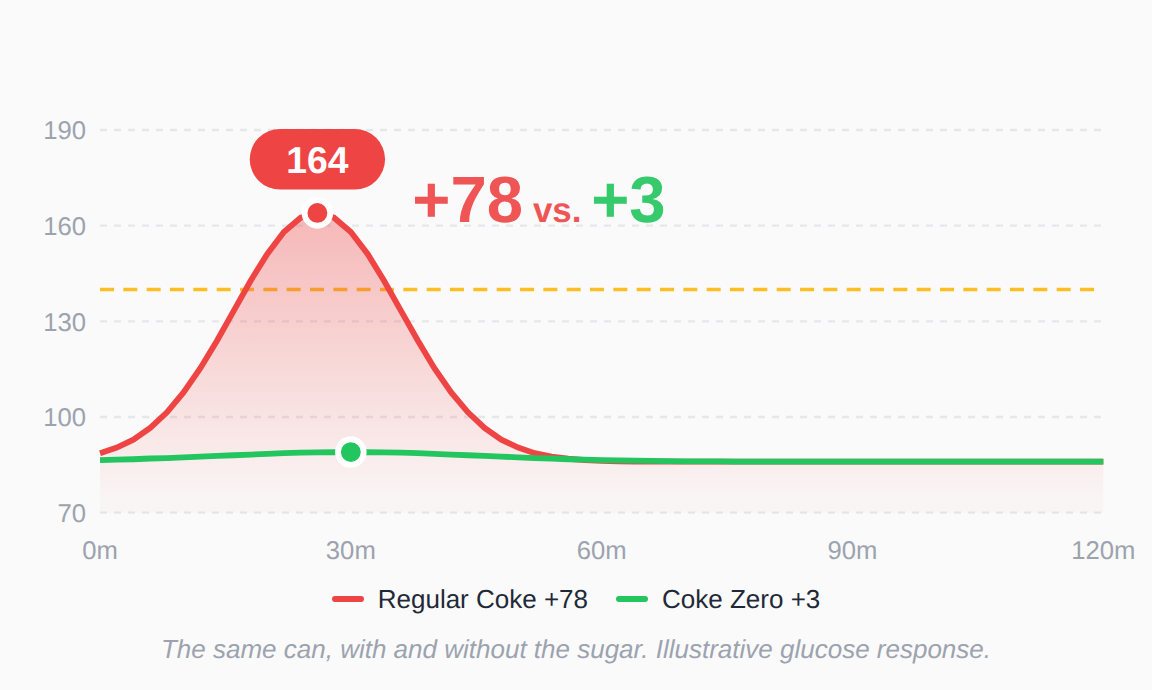
Seventy eight points against three. The second one is not a smaller version of the first. It is a different event. One of those lines has a peak and a fall. The other is a straight road. I keep coming back to how little separates them in the shop. Same shelf. Same red. Same cold. The decision takes under a second and most of us make it without looking. And it produces the two most different lines I have put on a chart since I started. What 39 grams looks like Thirty nine grams of sugar is nearly ten teaspoons. Nobody would sit down and eat nine or ten teaspoons of sugar. Dissolved in cold water with phosphoric acid and caffeine, it goes down in four minutes and barely registers as sweet by the end of the can. That is the whole trick of a soft drink. The cold and the acid and the bubbles take the edge off the sweetness, so your mouth stops warning you. Try one at room temperature if you want to understand what you are drinking. I did it once. It is syrup with a bitter note, and it is hard to get through half a glass. Cold does not change the sugar. It changes how much of it you notice. And liquid sugar has nothing holding it back. No fiber, no fat, no protein, nothing to chew. In other words, it reaches your blood about as fast as sugar can. Which is why one can beat every whole food I have tested, including the cup of grapes that started all this. The grapes carried 26 grams and came in at 66. The can carried 39 and came in at 78. More sugar, bigger rise. Nothing surprising in that. What is worth noticing is the shape. The grapes took a moment to get going, because even a grape has a skin and a gram or so of fiber. The can did not wait for anything. If you are going to make the swap
By the way, about the calories A can of Coca-Cola is 140 calories. The zero sugar one is nothing. One can a day for a year is about 51,000 calories, and roughly 14 kilograms of sugar. I am wary of numbers like that, because they make it sound as if swapping the can automatically means losing weight, and the evidence does not promise that. What the number is good for is scale. This one small change moves more sugar out of a year than almost anything else on my list, and it takes no willpower at the fridge door.
There is one more reason this particular swap is worth more than it looks. Most of the changes I have written about ask something of you at the table. Eat the salad first. Wait ten minutes. Walk after dinner. Put the grapes in a bowl. Every one of those needs you to remember it, in the moment, while hungry. This one you decide once, in a shop, and then it keeps paying out without you doing anything. You reach for the black can instead of the red one. That is the whole task. I have come to think that is the thing worth looking for. Not the change with the biggest number, but the change that keeps working on the days you are not paying attention. So here is where I have come out this week. If you are drinking the red can every day, the zero one is a better place to be, and my monitor is not subtle about it. If you are already drinking water, nothing here is an argument to start. And if you are somewhere in between, which is most of us, the honest answer is that the direction matters more than the destination. Two cans down to one is worth as much as one down to none. It is the same 39 grams either way. Tomorrow I answer the question sitting under this whole week. Are these sweeteners safe, and what did that headline about cancer say? — Stay steady |
The same can, with and without the sugar
A regular Coke raised my blood sugar 78 points. The zero sugar one raised it 3. The swap is worth making, and it is still not the same as drinking water.

This is one person's experiment with a glucose monitor, not medical advice. Everyone's body responds differently.
Browse every issue