|
Four mornings. Same loaf, same two slices, same empty stomach, same seven o'clock. Yesterday I mentioned the 2008 study that started me on this. Two researchers in England, ten volunteers, white bread treated four different ways. I wanted to know whether it would do anything for me. So I ran their four conditions on my own counter, one morning at a time. Fresh. Frozen and thawed. Toasted. And frozen, thawed, then toasted. Here are the two ends of it…
This is one person's experiment, not medical advice. Everyone's body responds differently. Twenty eight points between the first morning and the last. Same bread. Same amount of it. Only the handling changed. All four mornings
The toaster helped. The freezer helped more. And here is the part I did not expect. Freezing and thawing, with no toasting at all, got me most of the way there. A step that costs nothing, takes no effort, and only asks you to think about breakfast the night before. Why cold bread behaves differently When bread bakes, the starch granules swell and burst open. Picture a tight ball of yarn pulled loose across the floor. Loose starch is easy for your gut to pull apart. That is why warm bread moves your blood sugar so quickly. Then it cools. And the loose strands start finding each other again, winding back into a tighter, harder arrangement… Your small intestine cannot get into much of that. It travels on down to your gut bacteria instead. In other words, part of the bread stops counting as bread. This is also exactly what we mean when we say a loaf has gone stale. Staling and the hack are the same chemistry, running at the same time. How much, and does heating it again undo it? This April a team in Poland put a number on it. They cooked pasta, held it in the fridge for twenty four hours at about forty degrees Fahrenheit, then reheated it. Measured in a lab, the resistant starch went from eight grams per hundred to nearly thirteen. Around sixty percent more, from a night in the fridge. Then they fed both plates to thirty two adults, matched for carbohydrate, and watched what happened next. After the cooled and reheated plate, the peak rise was about a third smaller, and the total climb across two hours was down by roughly sixty percent. So that answers the question I had… Heating it again does not undo the cooling. One caveat, and it is a real one. Those were people living with type 1 diabetes, on insulin pumps, eating pasta. Not me, eating toast. The chemistry should carry across. The size of the effect may not. The thawing question, which I promised you The 2008 study thawed the bread before it went in the toaster. I had assumed you could go straight from the freezer, because that is how I usually eat frozen bread. They did not test that, and as far as I can find, nobody has. So here is the honest version. Thaw, then toast, is the route with evidence behind it. Toasting from frozen is my guess. It is probably fine… but a guess is not a finding, and I would rather tell you which is which.
Two things to skip Do not expect this to rescue a bad choice. A smaller number from the same bread is a smaller number, not a different food. Forty three is still forty three. And do not buy anything for this. No special container, no gadget. You own a fridge. The study that found nothing I should tell you about this one too. In 2021 another group ran almost the same idea on eight healthy men. Pasta, chilled overnight, reheated, against fresh hot pasta. No difference in blood sugar at all. The only thing that moved was how full people felt afterwards. Eight people is a small study. So is ten. So is thirty two. That is the real state of this one. The chemistry is settled. How much of it turns up on any particular person's monitor is still being argued over. Which is why I ran it on myself four times. And why I would rather you ran it on yourself than took my word for it.
My routine now is dull, which is how I know it will stick. I slice the loaf the day it comes home. Half goes in the freezer. The night before I want it, two slices come out onto a plate. In the morning, the toaster. Twenty eight points, for remembering something the night before. Tomorrow, three breads and one question. White, whole wheat, and sourdough. Guess which one wins before you scroll. — Stay steady |
The same bread, four ways. The gap was 28 points.
Fresh, frozen and thawed, toasted, and all of it together. One step does most of the work, and it is not the toaster.

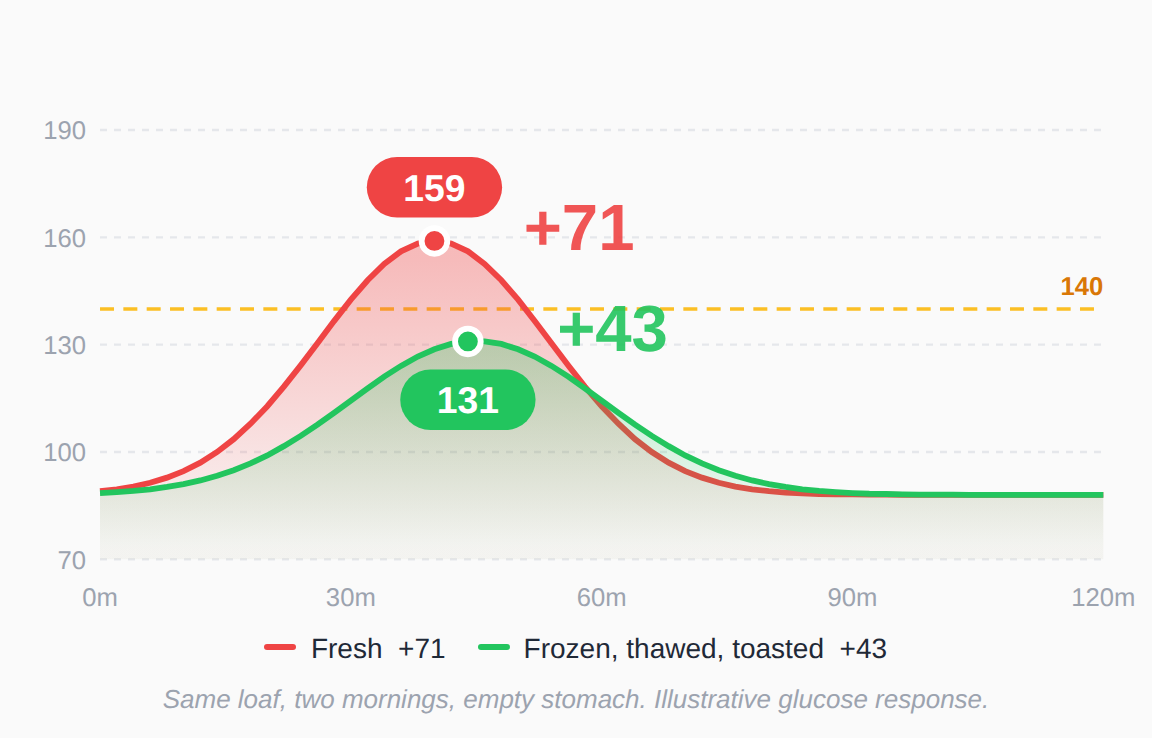
This is one person's experiment with a glucose monitor, not medical advice. Everyone's body responds differently.
Browse every issue