|
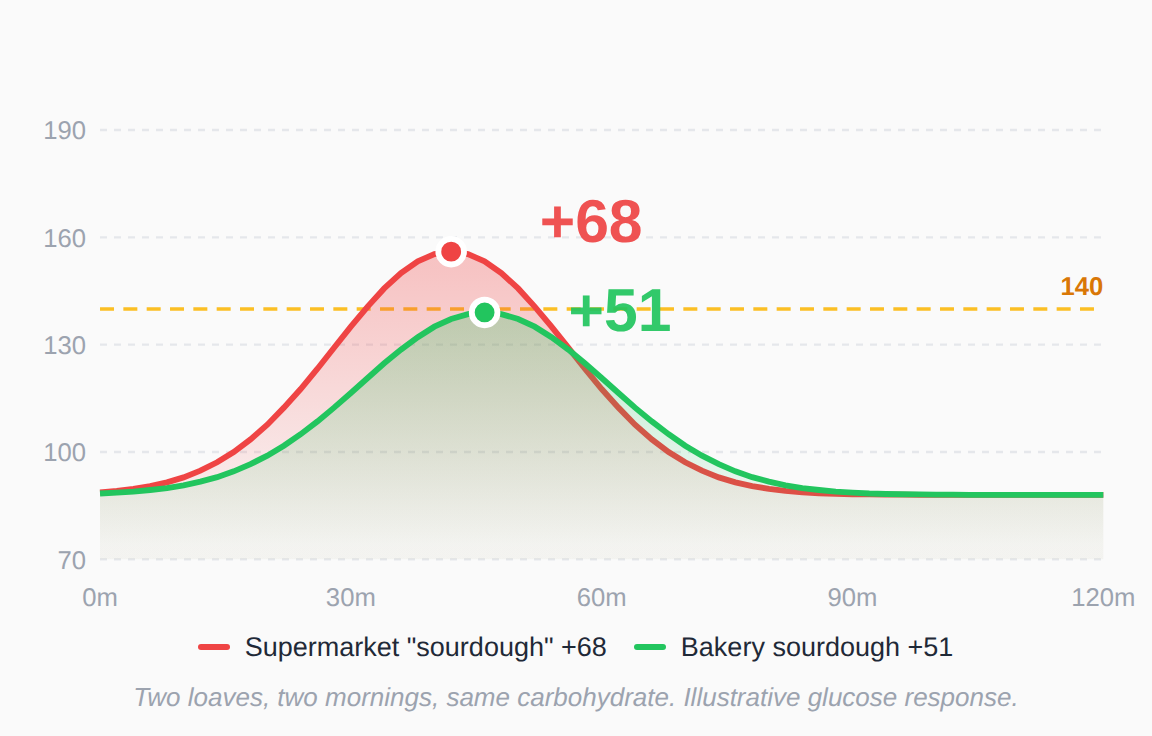
Two loaves. One word. On the left, the bakery loaf from Saturday. Eighteen hours, a starter the baker keeps in a tub, four ingredients if you count the water. On the right, a supermarket loaf with sourdough printed across the front in a handsome serif. I weighed both to the same carbohydrate and ate them on consecutive mornings.
This is one person's experiment, not medical advice. Everyone's body responds differently.
Seventeen points apart. And the supermarket loaf behaved almost exactly like the plain white bread from yesterday, which came in at 71. Three points from white. On a monitor that wanders by that much on its own, those are the same loaf. So I turned the bag over My supermarket loaf listed yeast. Real sourdough does not need yeast. The starter is the yeast, living alongside the bacteria that make the acid. Yeast on the ingredient list is a shortcut. It lifts a loaf in a couple of hours instead of overnight. Nothing wrong with that on its own. Most of the bread I have eaten in my life was raised that way, and it was fine bread. The problem is the word printed over it. And the hours are the whole point. That slow sit is when the bacteria make the lactic acid, and the acid is what changes how the starch sets as the loaf bakes. Take the hours away and you take the effect away. What is left is the shape of a sourdough with none of the chemistry. In other words, I paid for a long ferment and got a fast loaf with a good haircut. There is a number behind this, and it is small enough to be believable. A review in the British Journal of Nutrition found sourdough loaves carrying around five percent resistant starch, against roughly one and a half percent for bread raised with yeast. Resistant starch is the part your small intestine cannot unpick. It goes on down the line to your gut bacteria instead of into your blood. Three times as much of it, from nothing but time. That is the entire trick, and it is why a shortcut undoes it so completely. The consumer group Which? went through what goes into supermarket sourdough this March. Past flour, water and salt they found added yeast, ascorbic acid to make it rise faster and bigger, rice flour for a crunchier crust, soya flour for the crumb, vegetable oil for shelf life, and in some loaves vinegar. Vinegar is the honest giveaway. If a loaf has to be told to taste sour, the bacteria never got round to it. Ascorbic acid is the one I had to look up. It is vitamin C, and in a bakery it is there to push the dough up faster and bigger. Which tells you what the whole recipe is optimised for. Speed, volume, shelf life. All reasonable things for a company to want. None of them are the thing I was buying it for. And the tang fooled me completely. My supermarket loaf tasted properly sour. Sourness is a flavour, and flavour can be added in five minutes… the chemistry that flattens a curve cannot. Now the part that keeps this fair Some supermarket sourdough is the real thing. In Britain the Real Bread Campaign keeps a public list of supermarket loaves that meet their definition, and the list is not empty. Some of those loaves sit in the big chains. So this is not bakery good, supermarket bad. It is long ferment against short ferment. And the word on the bag does not tell you which one is in your hand. Which is a strange thing to be true in 2026, when the same bag will tell you the farm the wheat came from. The hack, if you are standing in the aisle
By the way, and this one is on me That review I mentioned on Monday found that very few trials matched the rising time between their two breads. Mine did not either. My two loaves differ in ferment time, flour, shape, crust, hydration and the building they were baked in. I changed everything at once. So take the seventeen points as an honest reading of two real loaves I bought and ate. Not as a controlled experiment. I am one person with a monitor and a toaster… and that is worth saying out loud on the day the numbers flatter my argument.
Tomorrow, the whole week on one page. And the question I have been dodging since Monday. Is any bread truly safe? — Stay steady |
Same word on both bags. Seventeen points apart.
A bakery loaf against a supermarket "sourdough", matched for carbohydrate. The label turned out to be the only thing they had in common.

This is one person's experiment with a glucose monitor, not medical advice. Everyone's body responds differently.
Browse every issue