|
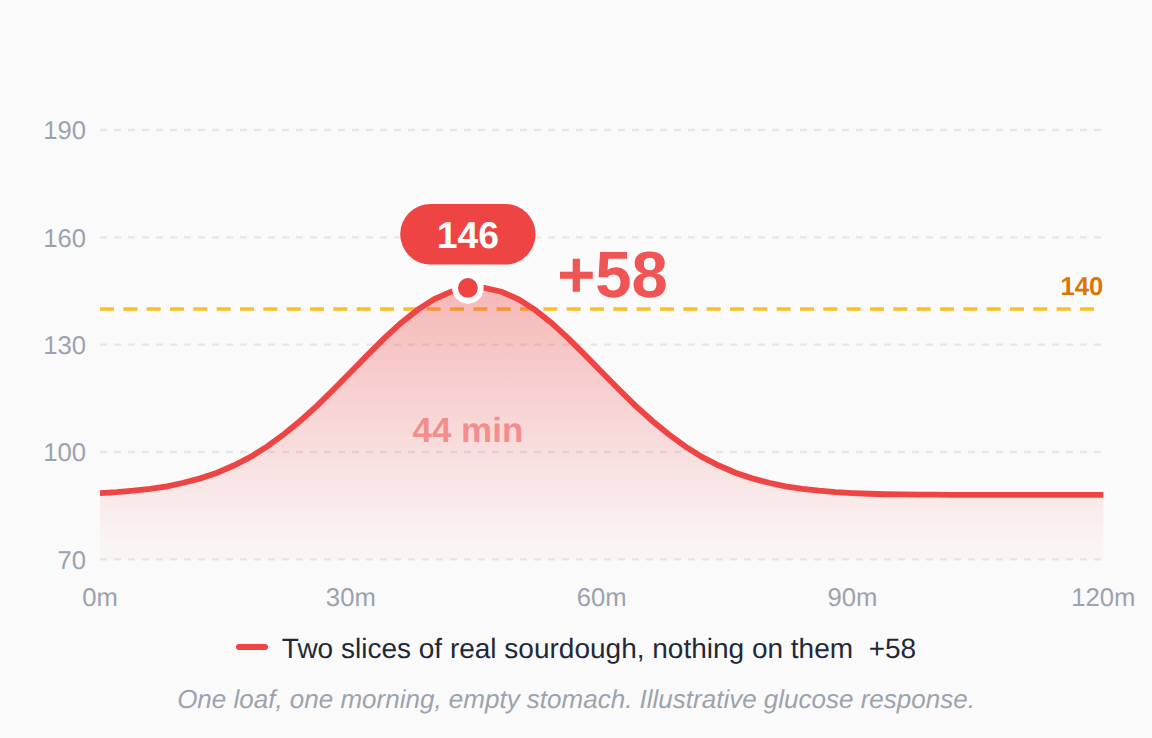
Saturday morning. I drove across town for this loaf. Not the supermarket one with the pretty slash across the top. A small bakery, a starter in a tub, eighteen hours of rising. This is the bread the internet has decided is the safe one. So on Sunday I ate two slices of it on an empty stomach. Nothing on them. No butter, no egg, no excuse. Here is what my monitor did for the next two hours…
This is one person's experiment, not medical advice. Everyone's body responds differently. Fifty eight points. Up to 146, about forty five minutes in. That is over the line I try to stay under. It is good bread. It is still bread. Why it went up anyway Sourdough does not remove the flour. A slice of bread is mostly starch, and starch is glucose molecules holding hands in a long chain. Your gut snips the chain apart and the glucose goes into your blood. In other words, the flour is the part that raises your blood sugar. Sourdough is a way of making flour into bread, not a way of taking the flour out. What the long wait does is slow the handover. While the dough sits, bacteria in the starter turn some of the flour into lactic acid. That acid changes how the starch sets as it bakes, and some of it ends up in a knot your gut cannot easily pick apart. Scientists call that resistant starch. A review in the British Journal of Nutrition put sourdough loaves at around five percent of it, against roughly one and a half percent for bread raised with baker's yeast. Three times as much. Still a small corner of the loaf. The effect is real. It is just smaller than the talk about it. Then I went looking for the studies They are thinner than I assumed. This August a group of researchers, including Germany's Max Rubner Institute, went through twenty seven human trials on fermented bread and blood sugar in healthy people. Twelve of those trials put sourdough directly against yeast bread. Ten of the twelve favoured sourdough. And yet the reviewers called the overall evidence neither sufficient nor convincing. Here is the line that stopped me. Very few of those studies matched the fermentation time between the two breads. Take one careful trial out of Sardinia. The sourdough sat for eight hours. The bread it was tested against sat for two. It came out lower. It also sat four times as long. So could the thing being measured be time rather than sourness? I do not know. Nobody has pulled the two apart yet… But it matters, because the supermarket loaf is sour and fast. That one goes on the same chart on Thursday. Meanwhile… the thing that did work I nearly skipped this one. It sounded too silly. In 2008, two researchers in England took white bread and did four things to it. Served it fresh. Froze and thawed it. Toasted it. And froze, thawed, then toasted it. Ten people. Not many, and I will not pretend otherwise. But the pattern held in both the loaves they tried. Freezing helped. Toasting helped. Doing both cut the glucose response by about forty percent against the fresh slice. So I froze half my expensive loaf. Tuesday morning, two slices straight from the freezer into the toaster.
Twenty one points off. Same bread, same morning routine, same person. Here is why it works. When starch cools, it re-knits into a tighter arrangement your enzymes find harder to open. Freezing it hard, then drying it with heat, tightens it further. Think of a loose pile of yarn against a tightly wound ball. Same yarn… one takes far longer to pull apart.
The bigger picture, and this is the part that bothers me No major market has a binding legal definition of sourdough. The FDA has a written rule for what whole wheat bread has to be. Nothing like it exists for sourdough. Same in Europe, Britain, Australia. So a loaf raised with commercial yeast in two hours, soured with a splash of vinegar or a scoop of dried sourdough powder, can sit under the same word as mine. France is the exception. They went at it like engineers. Their bread decree of 1993 says a loaf sold as pain au levain must carry at least 900 parts per million of its own acetic acid in the crumb, and a pH of 4.3 or lower. A pinch of baker's yeast is allowed at the end, up to two parts in a thousand. Past that, you lose the word. A number you can test in a lab, rather than a word you can print on a bag. Everywhere else, the word is free.
So where does that leave me? I will keep buying the real loaf. It is better bread, and its small effect points the right way… even if the science is softer than the posts suggest. But I have stopped treating it as a free pass. It is bread. It behaves like bread. And my freezer did more for that chart than the baker did. Tomorrow, the whole freeze and toast routine. How cold, how long, and what happens if you thaw it first. — Stay steady |
Real sourdough is better bread. It is still bread.
I drove across town for a proper long-fermented loaf. It took my blood sugar up 58 points. The thing that helped was in my freezer.

This is one person's experiment with a glucose monitor, not medical advice. Everyone's body responds differently.
Browse every issue